Suspension & Steering on the Ford F-150: Selection and Installation
How to choose suitable parts for suspension and steering on the Ford F-150, recognize wear and plan the installation safely.
Overview: Suspension and Steering on the Ford F-150
The suspension and steering of your Ford F-150 determine ride comfort, tracking and safety. Especially on a heavy pickup like the Ford F-150, high forces act on control arms, tie rods, shock absorbers and wheel bearings. Wear often develops gradually until the vehicle feels vague or tires wear unevenly.
So that you can select suitable parts and plan the installation sensibly, you should know the basic assemblies and common wear patterns. This guide focuses exclusively on the Ford F-150 and explains what to watch for when choosing, checking fitment and installing components.
Key Components of Suspension and Steering on the Ford F-150
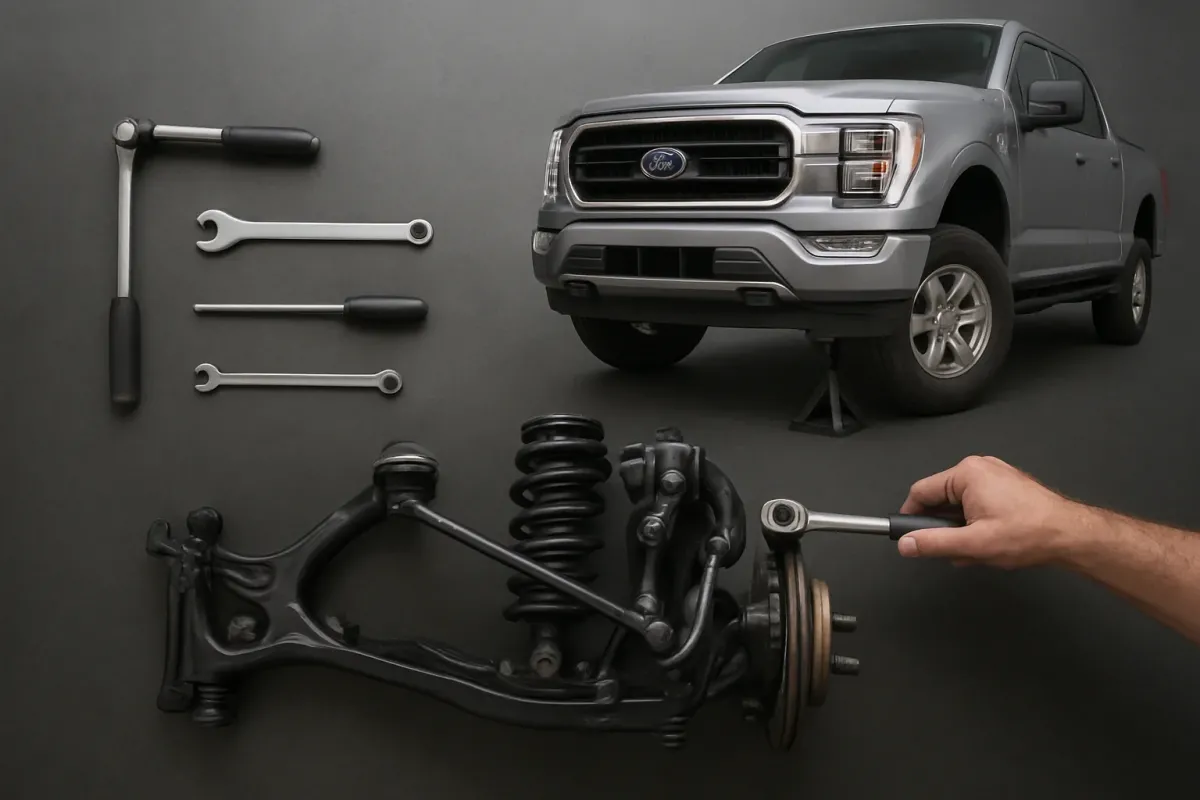
The front suspension of the Ford F-150 essentially consists of the following assemblies:
- Control arms (usually upper and lower, with ball joints)
- Tie rods and tie rod ends (inner and outer)
- Shock absorbers or struts with upper mounts
- Wheel hubs with integrated wheel bearings
- Bushings (rubber mounts in control arm mounts and anti-roll bar)
- Rear axle: leaf or coil springs and shock absorbers
An overview of suitable categories for suspension and steering for your Ford F-150 can be found at Federung & Lenkung. Always select the exact vehicle there first to display compatible parts.
Control Arms and Ball Joints
Control arms connect the frame or subframe to the wheel hub and guide the wheel vertically. Bushings and often integrated ball joints are located in the control arms. Play in the ball joints or worn bushings lead to:
- Clunking or popping when driving over undulations
- Imprecise steering and "wandering" in ruts
- Uneven tire wear (especially inside/outside)
For many Ford F-150 variants there are complete control arms including ball joint, for example Upper front control arm left for Ford F-150 & Expedition 4WD. Always check fitment using the vehicle selection in the shop and your vehicle documents.
Tie Rods and Tie Rod Ends
Tie rods transmit the steering movement from the steering gear to the front wheels. Worn tie rod ends cause:
- Play in the steering (steering wheel has a "dead" zone)
- Clicking noises when maneuvering or at full lock
- Misaligned toe and rapid tire wear
Inner tie rod ends are located at the steering gear, outer tie rod ends at the steering knuckles. Example: 2x inner tie rod end for Ford F-150. Pay close attention to drive type (2WD/4WD) and production period.
More steering components can be found under Tie Rods & Ends.
Wheel Hubs and Wheel Bearings
On the Ford F-150, hub and wheel bearing are often bolted as a unit. Typical symptoms of failing wheel bearings:
- Howling or grinding noise, dependent on engine/road speed
- Play at the wheel when checking at the 12 and 6 o'clock positions
- Heating of the hub after a short drive
There are different hub assemblies for various model year groups, for example:
- Front hub with wheel bearing for Ford F-150 1997–2000 4WD
- Front hub with wheel bearing for Ford F-150 2001–2003 4WD (5 wheel studs)
- Front hub with wheel bearing for Ford F-150 2005–2008 4WD
There is a dedicated category for wheel bearings, hubs and bushings: Wheel Bearings, Hubs & Bushings.
Shock Absorbers, Struts and Mounts
Shock absorbers and struts absorb the oscillations of the springs and ensure the tires stay in contact with the road. Worn dampers are noticeable by:
- Vehicle continuing to oscillate after bumps
- Longer braking distances and tendency to "nose-dive" under braking
- Unsettled rear when towing a trailer
When replacing, dampers should ideally be renewed axle-wise. Suitable parts can be found under Shock Absorbers & Struts and the upper mounts under Shock & Strut Mounts.
Springs: Leaf Springs and Coil Springs
Depending on configuration, the Ford F-150 is equipped with leaf springs at the rear and coil springs up front. Overloading, heavy off-road use and corrosion can fatigue or break springs. Signs:
- Vehicle visibly sags on one side or overall lower
- Thumping noises from the rear axle under load
- Uneven gaps between tire and fender
Springs must match the suspension, permitted axle load and specification of your Ford F-150 exactly. Use the category Leaf & Coil Springs and select your model there.
Selecting the Right Parts for Your Ford F-150
Since the Ford F-150 exists across many generations with different axle and steering concepts, fitment checking is crucial. Important are:
- Vehicle Identification Number (VIN) – helps with exact identification
- First registration and model generation
- Drive type (2WD or 4WD)
- Axle loads according to vehicle documents
- special equipment (e.g. heavy-duty suspension)
If in doubt, match the technical details in the shop with your vehicle documents and – if available – the OEM numbers of the removed parts. If you are unsure whether a complete set like the Control Arm & Tie Rod End Front Set for Ford F-150 fits your vehicle, always check via the vehicle listing in the shop.
Recognizing Wear: Inspect, Don’t Guess
Before ordering parts, you should know exactly what on the Ford F-150 is actually worn. A systematic inspection of the front axle helps avoid wrong purchases.
Checking the Steering
- Lift the front of the vehicle, wheels hanging free.
- One person moves the steering wheel slightly back and forth.
- You observe tie rods, tie rod ends and idler arms for play.
- If necessary, apply light pressure to joints with a pry bar; play becomes visible.
Pay special attention to torn boots on tie rod ends – once dirt enters, wear is usually advanced.
Checking Control Arms and Bushings
- Hold and shake the wheel horizontally and vertically.
- Play in the upper/lower area can come from ball joints.
- Inspect control arm bushings with a light: look for cracks, extruded rubber, corrosion.
Checking Wheel Bearings
- Spin the wheel freely by hand, listen for noises.
- If necessary, check with a stethoscope or a screwdriver (as a listening aid at the ear).
- Grab the wheel at 12 and 6 o'clock and rock it – noticeable play is a clear sign.
Installation Notes for Ambitious DIYers
The Ford F-150 is built robustly, but when working on suspension and steering you should proceed systematically. The following notes are general and do not replace the vehicle-specific repair manual.
General Safety
- Secure the vehicle on level ground, engage a gear or "P", apply the parking brake.
- Only work with tested jacks and jack stands; never work under a vehicle supported only by a jack.
- Always replace components in pairs when they are changed axle-wise (e.g. shock absorbers).
- After work on steering or suspension geometry, a professional wheel alignment is mandatory.
Typical Work Steps (Examples)
Replacing front control arm (example procedure, not a complete guide):
- Remove the wheel, secure the brake assembly and any sensor lines.
- Disconnect the ball joint at the steering knuckle (use a suitable puller, do not hammer on the stud thread).
- Loosen the control arm bushing bolts at the frame.
- Remove the control arm, clean the contact surfaces.
- Fit the new control arm, initially tighten bolts by hand only.
- Bring the vehicle to normal ride height (load the axle), then tighten the bushing bolts to the specified torques.
Torque values are model-dependent. Always use the values from the workshop manual or official Ford documentation.
Replacing outer tie rod end (example):
- Mark the length or count turns on the old tie rod end when unscrewing.
- Loosen the clamp on the tie rod.
- Separate the taper at the steering knuckle with a suitable separator.
- Screw the new tie rod end in to approximately the same position (use the mark).
- Seat the taper and tighten to the correct torque.
- Secure the clamp.
This procedure is intended only to get the toe roughly correct for driving to an alignment. Precise adjustment is only possible on an alignment rack.
Replacing front hub with wheel bearing (example):
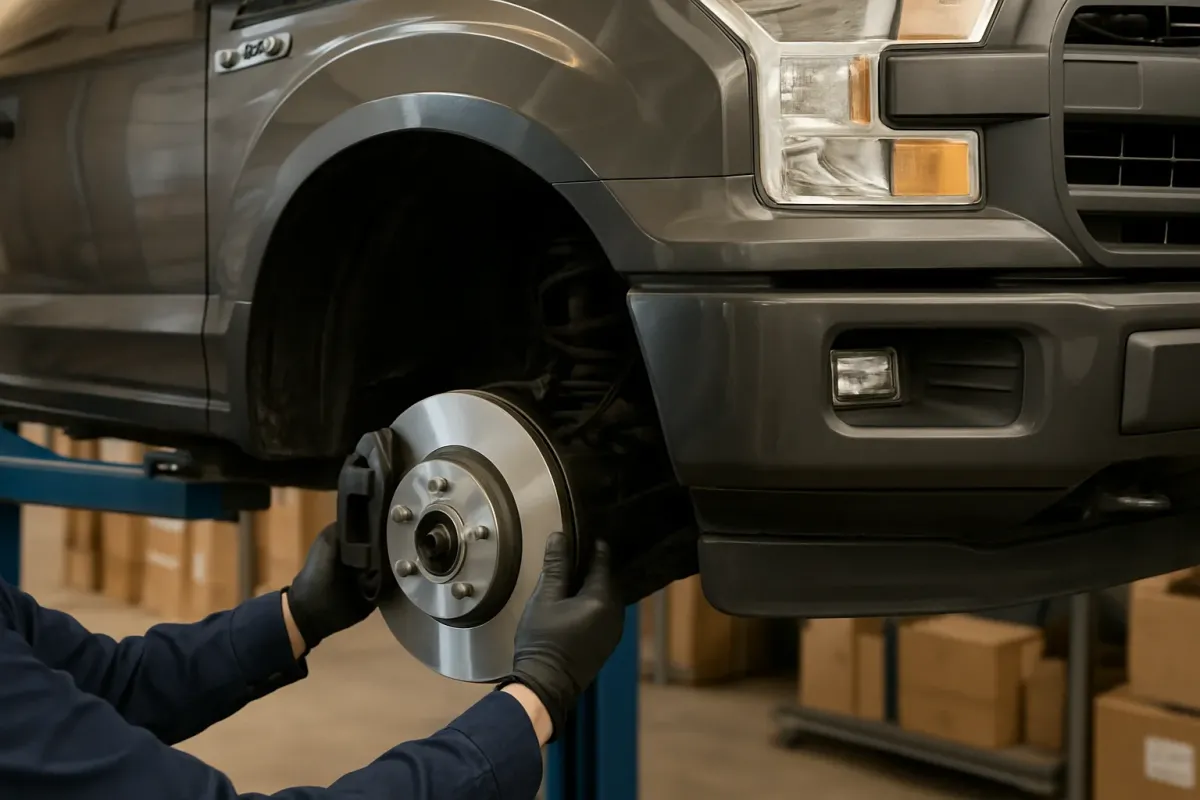
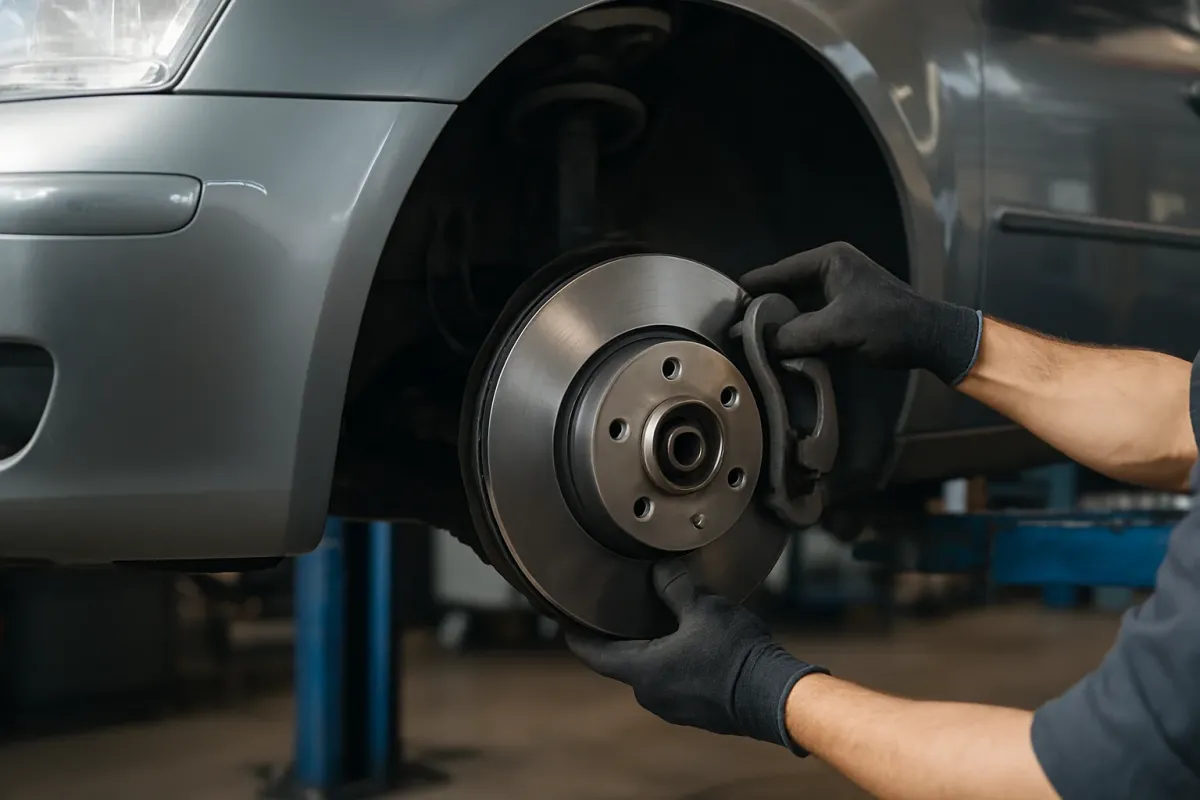
- Remove wheel and brake components (caliper, disc).
- Disconnect the plug of the ABS sensor (if present).
- Loosen the hub attachment from the steering knuckle (usually several bolts from the back).
- Pull off the old hub, clean contact surfaces and remove rust.
- Fit the new hub, tighten the fastening bolts to the correct torques.
- Reconnect ABS sensor, refit brake and wheel.
Here too, torques and tightening sequence depend on model year and axle construction. Always consult the corresponding repair manual.
After Installation: Check and Test Drive
After working on the suspension and steering of your Ford F-150, the following checklist is recommended:
- Have all bolts and nuts been tightened to the specified values?
- Have all cotter pins, locking plates and clamps been replaced and correctly installed?
- Are brake lines, ABS wires and vent hoses routed without tension?
- Are wheels tightened to the specified torque?
Then perform a cautious test drive:
- Drive slowly, listen for noises and feel for vibrations.
- Perform light brake tests, is there any pulling to one side?
- Steer to full lock in both directions, listen for clunking or rubbing noises.
Finally, a professional wheel alignment is important, especially after replacing control arms, tie rods, springs or wheel bearings.
Common Mistakes When Working on the Ford F-150
- Tightening bushings in the uncompressed state: This leads to preloading and premature tearing of the rubber mounts. Always tighten in the normal ride height position.
- Wrong parts due to inaccurate model information: Always check VIN, drive type and production period.
- Skipping wheel alignment: Especially on the F-150 with its long wheelbase, incorrect toe has a strong effect on tires and handling.
- Reusing torque-to-yield bolts or self-locking nuts: If the manufacturer specifies them as one-time-use fasteners, replace them.
Frequently Asked Questions
Do I need a wheel alignment after every control arm replacement on the Ford F-150?
Yes. Work on control arms, tie rods, ball joints or springs changes the suspension geometry. A wheel alignment according to the manufacturer's specifications is necessary to set toe, camber and caster correctly and to avoid tire wear and poor handling.
Can I replace only one tie rod end or only one side on the Ford F-150?
Technically, replacing one side is possible, but it is recommended to work in pairs on an axle. Especially with high mileage, opposite parts are usually worn similarly. After any intervention on the steering, a wheel alignment is advisable.
Where can I find the correct torque specifications for suspension and steering parts?
Torque values vary by model year, configuration and axle design of the Ford F-150. Do not rely on generic tables from the internet. Use the official workshop manual, repair databases or Ford technical documentation to obtain the correct torque specs for your vehicle.