Front & Radiator Grilles for US Cars: Selection and Installation
How to find the right front or radiator grille for your US car, what to watch for regarding fitment and materials, and what is important during installation.
Function and Construction of Front & Radiator Grilles
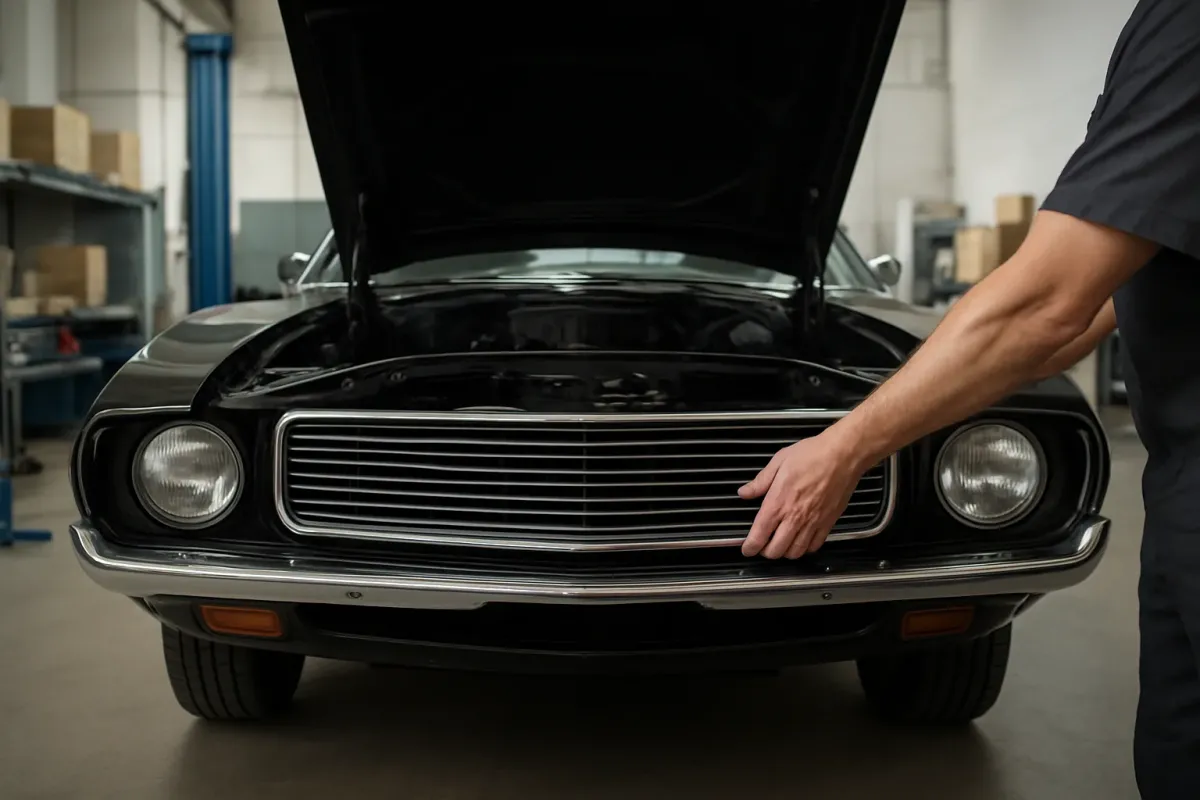
The front or radiator grille is more than a design element. It defines the appearance of your US car and also has technical functions. It partially protects the front end from stone chips and larger foreign objects while at the same time allowing sufficient airflow to the radiator, intercooler and, where applicable, oil cooler.
When modifying, you must therefore always consider aesthetics and technical aspects together: a closed or too-finely meshed grille can reduce cooling performance, while a very open grille leaves sensitive cooling assemblies less protected. Many aftermarket grilles replicate the OEM airflow but are executed with a significantly more aggressive look.
Types of Radiator Grilles on US Cars
US vehicles like the Mustang, Challenger, F-150 or Ram 1500 use different grille concepts that can be roughly divided as follows:
- Upper main grille: sits between the headlights, shapes the front view most strongly, often with a brand or model emblem.
- Lower grille / air intake: in the lower bumper area, often designed as a separate part, important for the radiator and brake cooling.
- Grilles with integrated daytime running lights / LED strips: aesthetic tuning plus improved visibility in traffic.
- Model- or style-specific grilles: for example RTR-style on the Ford Mustang or Shelby-style on the F-150, which are modeled on the design of well-known performance variants.
An overview of various versions for different US models can be found in the category Front- & Kühlergrills.
Fitment: What to Watch for When Choosing
The most important rule: front grilles are generally vehicle- and model-year-specific. Even a few model years' difference can mean different mounting points, sensor housings or contours. Therefore always check:
- Vehicle model (e.g. Ford Mustang, Dodge Ram 1500, Dodge Challenger, Ford F-150)
- Series and model years (e.g. Mustang 2015–2017, Ram 1500 2019–2025)
- Body variant and equipment (e.g. Ecoboost, SRT/Hellcat, vehicles with front camera, parking sensors or radar sensors)
Examples:
- For the Dodge Ram 1500 (2019–2025) there are various grilles with integrated LEDs, for example in gloss black or matte black. Both are vehicle-specific but differ in surface finish.
- With the Ford Mustang you additionally have to distinguish between pre-facelift (e.g. 2015–2017) and facelift (from 2018). For the lower grille area of the facelift there is, for example, a separate lower grille 2018–2023.
Also check whether the grille is explicitly approved for vehicles with sensors (distance radar, front camera, parking sensors) or has corresponding cutouts. If you are unsure, carefully compare the product images with your original grille and, if in doubt, also check the vehicle documentation or repair manual.
Materials, Finishes and Quality
Aftermarket radiator grilles are generally made of plastic, usually ABS or a similar impact-resistant material. These materials are light, corrosion-free and comparatively easy to paint if the surface permits.
Common surface variants:
- Gloss black: looks premium, matches chrome or clear-lens headlights well, requires more care (wash scratches).
- Matte or textured black: less sensitive to small scratches, looks more technical and often more "off-road oriented".
- Grilles with mesh or honeycomb pattern: sportier look; a stable mesh construction is important so nothing warps or breaks.
Avoid driving long-term with an unpainted or only primed grille if it is not intended for that purpose. UV exposure can cause plastic to fade or become brittle. Consider the manufacturer's instructions regarding paintability.
LED Grilles and Type Approval Aspects
Many modern aftermarket grilles have integrated LED strips or spots. They are usually used as daytime running lights or position lights and are an important design factor, for example in RTR-style grilles for the Mustang or Shelby-style grilles for the F-150.
Important points regarding LED grilles:
- Approval: Pay attention to the manufacturer's information on road legality. Some products are explicitly supplied with a TÜV note, such as the Shelby-style grille for the Ford F-150 2021–2025.
- Electrical connection: The connection should be made according to the manufacturer's specifications. Follow the supplied wiring diagram and the vehicle documentation. Uncertain or makeshift power taps should be avoided.
- Position and light color: Daytime running lights and position lights must meet legal requirements regarding mounting height, spacing and light color. You should consult the applicable regulations and test documents.
If you are not sure whether your grille with integrated LEDs is road-legal, clarify this in advance with a testing organization. This will help you avoid trouble at the next main inspection.
Preparation: Removing the Original Radiator Grille
The exact procedure differs significantly between models. Therefore always follow the vehicle-specific repair manual or workshop manual. In general, the following steps have proven effective:
- Secure the vehicle: Park on level ground, apply the parking brake. Depending on the work step, chock the front wheels or raise the vehicle on jack stands.
- Disconnect the battery: Especially important on vehicles with front sensors or LED components to avoid error messages or short circuits. The vehicle documentation contains information on stored settings and window regulator relearning.
- Remove trim cover: Many US cars have a plastic trim panel above the grille that is fastened with clips or screws. Carefully release this with a trim removal tool or plastic wedge.
- Remove bumper (if necessary): On modern vehicles the grille is often integrated into the bumper. Removal then requires undoing screws and clips in the wheelhouse area and under the vehicle. Be sure to document the sequence and positions (take photos).
- Disconnect plugs: Before removing the grille, disconnect all electrical connectors (LEDs, sensors, camera). Check the locks first; do not pull with force.
- Prise out or unscrew the grille: The original grille is usually attached with clips, screws or a combination of both. Carefully release clips with appropriate tools to avoid damaging the mounts on the bumper.
Installing the New Front or Radiator Grille
When installing, you basically proceed in reverse order. Important points:
- Compare with the original part: Before installation, place the new grille and the old grille side by side. Check mounting points, mounts for emblems, sensors and LEDs.
- Reuse seals and clips: Often rubber seals, retaining clips or metal clips must be transferred from the original part. Replace damaged clips.
- Trial fit: Initially fit the grille without fully tightening to check gap dimensions. Only when everything sits without stress, tighten or clip in finally.
- Torque specifications: If the manufacturer specifies torque values for screws, strictly adhere to the values in the workshop manual or technical documentation. Do not overtighten "by feel" to avoid damaging plastic fasteners.
- Connect electrics: Connect LEDs and sensors according to the wiring diagram. Route cables so they cannot chafe on sharp edges or be pinched by steering lock or suspension travel.
Examples of Typical Modifications
Some typical configurations you as a mechanic will frequently encounter:
- Sporty look on the Mustang: Replacing the factory grille with a more aggressive RTR-style grille with LED strips, for example for Mustang 2013–2014 or 2015–2017. Additionally, the lower grille, e.g. lower grille for Mustang 2015–2017 Ecoboost Premium, can be adapted to achieve a coherent overall appearance.
- Hellcat look on the Challenger: On the Dodge Challenger 2015–2023 a specific lower grille in SRT/Hellcat style can be used, such as the lower Hellcat grille. Here you should pay particular attention to sufficient airflow for intercooler and engine radiator.
- Distinctive truck look on the Ram 1500: A robust grille with integrated LEDs on the Dodge Ram 1500 emphasizes the vehicle's width and creates an independent front face, provided the airflow matches the original and does not impair the function of the cooling assemblies.
Fine Tuning: Gaps, Noise and Checks
After the modification you should not only check the result visually but also assess it technically:
- Gap dimensions: Transitions between grille, headlights and bumper should be even and not under stress.
- Noise development: On a test drive on the highway watch for whistling or rattling noises. Causes can be loose clips, not properly engaged mesh inserts or open cable channels.
- Observe coolant temperature: Especially after significantly altered grille geometry, monitor engine temperature. Unusual temperature rises can indicate restricted airflow.
- Test electrical functions: Systematically check LEDs, daytime running lights, indicators (if integrated), front camera and parking sensors. Take error messages in the instrument cluster or diagnostic tool seriously and troubleshoot the cause.
Safety and Legal Notes
Even though many front and radiator grilles are cosmetic tuning items, they can affect safety-related systems. Therefore note:
- Airbag and sensor systems: Some radar sensors for autonomous emergency braking or adaptive cruise control are located behind the grille or in the bumper area. Incorrect position or shielding can impair function. Consult the vehicle documentation for details.
- Approval and registration: For some grilles, especially those with lighting, certificates or TÜV notes may exist. Keep all documents and present them if required at the main inspection.
- Pedestrian protection: Sharp-edged custom constructions or non-matched metal meshes can cause issues with pedestrian protection. Use only parts that are intended for your model.
Common Mistakes When Modifying a Grille
- Ordering the wrong model: Model years or facelifts are often overlooked. Always match the full designation and production year.
- Broken clips: Plastic clips become brittle with age. Use appropriate removal tools and keep spare clips ready.
- Poor cable routing: Makeshift routing can lead to cable breaks or short circuits. Always secure cables and protect them from chafing.
- Lack of documentation: Without the repair manual you often pull or lever in the wrong place. This can lead to cracks in the bumper or broken mounts.
Conclusion
A new front or radiator grille significantly changes the look of your US car and — if chosen correctly — can be installed without disadvantages for cooling and function. Crucial are a precise check of model, year and equipment, a careful removal of the original part and a professional installation with attention to all electrical connections and sensors. With some planning and the right documentation, replacing the grille is a very doable project for ambitious hobby mechanics.
Frequently Asked Questions
Do I always have to remove the bumper to fit a new radiator grille?
That depends on the vehicle. On many modern US cars (e.g. Mustang from 2015, Ram 1500, F-150) the grille is integrated into the bumper, so it is usually necessary to remove the bumper for a correct and damage-free removal. The exact procedure is described in your vehicle's repair manual.
Can I just connect LEDs in the grille to the parking light?
That depends on the design of the LEDs and the legal requirements. Not every LED strip is approved as a daytime running light or position light. Follow the manufacturer's connection instructions and check the approval documents. If in doubt, clarify the setup with a testing organization.
Can a different grille increase engine temperature?
Yes, if the airflow through the grille is significantly reduced or air deflectors are missing, cooling performance can decrease. Monitor the coolant temperature after a modification and compare it with normal operating behavior. If there are anomalies, inspect the modification and, if necessary, adjust it.