Brakes & Brake Parts for Ford Explorer: Selection and Installation
Ford Explorer brakes: what to check before buying. Compare vehicle fitment, kit contents and relevant products.
Basics of the brake system on the Ford Explorer
The Ford Explorer is a relatively heavy SUV, and the demands on the brake system are correspondingly high. Anyone who wants to work on it themselves should know the construction of the brakes in order to choose suitable parts and perform the installation safely.
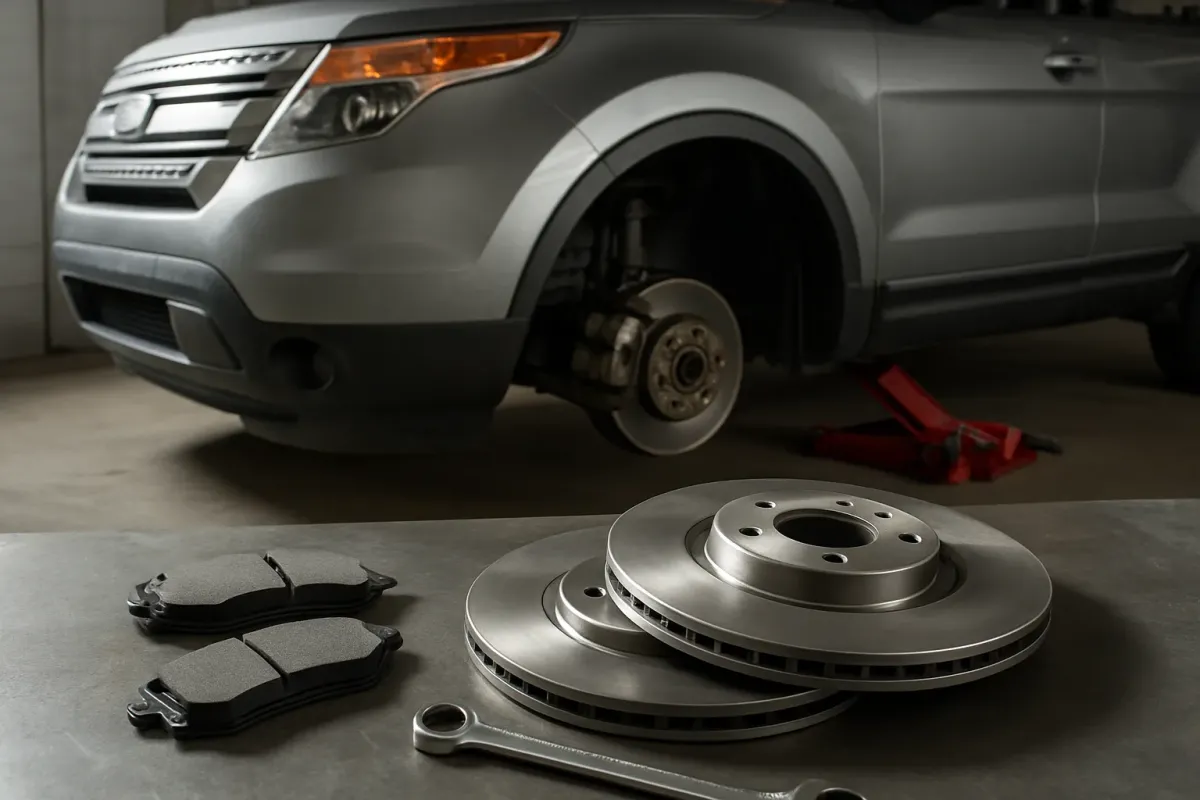
Typically the Ford Explorer uses disc brakes and brake pads at the front, and at the rear depending on the model either discs or a combination of a disc with an integrated drum for the parking brake. The exact configuration depends on model and equipment and must always be checked via the vehicle registration, VIN or the vehicle specification in the shop.
Important brake parts for the Ford Explorer
For maintenance and overhaul of the brakes on the Ford Explorer, the following components are especially relevant:
- Brake discs / rotors (front and rear)
- Brake pads
- Brake calipers and caliper brackets
- Brake shoes (if the parking brake is executed as a drum)
- Wear sensors (if present)
- Installation accessories: anti-rattle plates, clips, guide pins, rubber boots
An overview of suitable components for the Ford Explorer can be found in the category Bremsen & Bremsenteile.
Choosing the right parts for your Ford Explorer
Ensure fitment using vehicle data
For the Ford Explorer there are different brake configurations depending on year of manufacture, axle load, engine variant and brake system (standard, heavy duty, police package etc.). For a safe assignment you should:
- Have the vehicle registration (HSN/TSN, year of manufacture) ready
- Note the chassis number (VIN)
- Compare the brake system on the vehicle (rotor diameter, caliper design)
If in doubt, compare the measurements of the existing brake discs (diameter and thickness) and, if necessary, the shape of the pads with the product images. For example, there are front brake pads for Ford Explorer model year groups such as:
- BRAKE PADS / FRONT BRAKE PADS FOR FORD EXPLORER MOUNTAINEER 1995 - 2001
- BRAKE PADS / FRONT BRAKE PADS FOR FORD EXPLORER MERCURY MOUNTAINEER 2002 - 2005
- BRAKE PADS / FRONT BRAKE PADS FOR FORD EXPLORER TAURUS FLEX 2013 - 2019 325mm
Which version fits your Explorer must always be verified based on the vehicle documentation and the information in the shop. Do not install parts that only look “similar” by eye.
Ceramic or semi-metallic pads?
Many Ford Explorer drivers face the choice between ceramic and semi-metallic brake pads:
- Ceramic pads: generally produce less brake dust, are often quieter, and tend to be gentler on the rotors, but can have different cold braking behavior.
- Semi-metallic pads: often a bit more aggressive in initial bite, but usually produce more dust and run somewhat rougher.
For the Ford Explorer there are e.g. ceramic brake pads including accessories. When choosing, always make sure that “Ford Explorer” and the area matching your vehicle are specified. An example of such pads is:
CERAMIC FRONT BRAKE PADS + ACCESSORIES FOR FORD EXPLORER/TAURUS/FLEX / LINCOLN MKS
Rear brake pads on the Ford Explorer
Depending on the brake system, the rear brakes are either simple disc brakes or combinations with an integrated drum brake for the parking brake. Accordingly, the pads or brake shoes differ.
Examples of rear pads that are also listed for the Ford Explorer show how different the applications can be:
- REAR BRAKE PADS FOR FORD EXPLORER TAURUS 2013 - 2018 HD BRAKES
- REAR BRAKE PADS FOR MERCURY MOUNTAINEER FORD EXPLORER 2002 -
Whether your Ford Explorer has a heavy-duty brake system must be clarified based on the vehicle data and the information in the shop.
Complete kits or individual parts?
When replacing the brakes on the Ford Explorer, a complete replacement per axle is often worthwhile:
- Brake discs in pairs
- Brake pads for both wheels of the axle
- If applicable, new anti-rattle plates, clips, spring clips
In the category Bremsenkomplettsätze you can check whether suitable sets are available for your Ford Explorer. The advantage: all parts are matched to each other, and you reduce the risk of forgetting a part.
Required tools and preparation
For brake service on the Ford Explorer you should allow sufficient time and a clean working environment. In general you need:
- Stable jack and jack stands
- Lug wrench or impact wrench (depending on equipment)
- Socket and combination wrench set, usually in inch sizes
- Torque wrench (refer to the repair manual for tightening values)
- Brake piston compressor or a suitable pliers
- Wire brush, brake cleaner, rags
- High-temperature brake grease (only on sliding surfaces, not on friction surfaces)
Before you start, read the repair manual or the technical documents for your Ford Explorer:
- Tightening torques for wheel bolts, caliper bolts and brackets
- Special notes for vehicles with an electronic parking brake (if present)
Installation of brake pads and brake discs on the Ford Explorer
1. Secure the vehicle
- Park the vehicle on a level surface, select first gear / P position, apply the parking brake (unless working on the rear first).
- Loosen the wheel nuts slightly.
- Lift the vehicle with a jack and place it on jack stands.
- Completely remove the wheels.
2. Remove caliper and pads
- Loosen the caliper top and bottom (bolts according to the manual).
- Carefully remove the caliper and hang it with wire or a hook so the brake hose is not stressed.
- Remove old brake pads and any retaining clips.
- Remove the caliper bracket if the brake disc is to be removed.
3. Remove the brake disc
- Loosen any retaining screws of the brake disc.
- Pull off the brake disc. For seized discs, gently loosen from the rear with a rubber hammer.
- Thoroughly clean the hub surface with a wire brush so that the new disc seats flat.
4. Install new brake disc and pads
- Degrease the new brake disc (remove transport/corrosion protection with brake cleaner).
- Place the disc and, if applicable, fix it with the retaining screw.
- Clean the caliper bracket, lightly apply suitable brake grease to the sliding surfaces.
- Install new retaining clips/anti-rattle plates if provided.
- Carefully retract the brake piston with a piston tool, watching the brake fluid level.
- Install new brake pads (pay attention to correct inner/outer position).
- Reinstall the caliper and tighten to the torque values specified in the manual.
5. Rear axle and parking brake
The rear brakes on the Ford Explorer can be somewhat more complex depending on the design, especially if brake shoes for the parking brake are integrated inside the brake disc. The general procedure:
- Remove caliper and pads as at the front.
- If present: remove the brake disc and check the drum brake shoes located underneath.
- Replace worn brake shoes along with springs and retaining clips (typically a complete set per axle is replaced).
- Adjust the parking brake mechanism according to the repair manual.
For rear brake shoes and other parts the category Bremsbacken can be helpful.
Inspection, bleeding and bedding-in
Inspect the brake system
- Visually check all fastenings again.
- Check brake lines and hoses for damage or leaks.
- Check the brake fluid level and top up if necessary according to manufacturer specifications.
Bleeding the brakes (if required)
If the hydraulic circuit was opened or there is a spongy pedal feel, bleeding is required. The sequence and procedure can vary depending on the ABS/ESP system of the Ford Explorer. The correct procedure is described in the repair manual and should be followed exactly.
Bedding-in procedure
New brake discs and pads on the Ford Explorer should always be bedded in correctly:
- Avoid heavy emergency braking in the first kilometers.
- Perform several medium-intensity stops from moderate speed so a uniform friction layer builds up.
- Plan short cooling periods between braking events.
Common mistakes during brake service on the Ford Explorer
- Wrong parts ordered: Brake pads or discs do not match the installed brake system. Always check part numbers and dimensions.
- Hub surface not cleaned: Leads to runout in the brake disc and vibrations when braking.
- Guide pins not cleaned/serviced: Caliper can seize, causing uneven pad wear.
- Ignoring tightening torques: Bolts that are too tight or too loose can cause damage or safety risks.
- Pads not properly guided: Incorrectly seated clips or cocked pads cause noise and poor brake contact.
Additional brake parts and accessories for the Ford Explorer
In addition to discs, pads and shoes, a complete service on the Ford Explorer also includes:
- Brake calipers and caliper brackets, if seized or leaking
- Wear sensors, if present
- Small parts such as guide pins, rubbers, clips
Such parts can be found, among others, in the category Bremssättel & -halterungen as well as in the category Sonstige.
Frequently asked questions
How do I find the right brake pads for my Ford Explorer?
Crucial are year of manufacture, axle (front/rear), brake system variant and possibly specifications like “Heavy Duty”. Use the vehicle registration and chassis number and compare the shop information with your vehicle data and — if necessary — the measurements of the existing parts. If in doubt, refer to the vehicle specification in the shop or the repair manual.
Do I always have to replace brake discs in pairs per axle on the Ford Explorer?
Yes, brake discs should always be replaced axle-wise (i.e. left and right together). Only then is uniform braking behavior ensured. In addition, new pads should always be fitted with new discs to avoid seating problems and uneven wear.
What tightening torques apply to calipers and wheel bolts on the Ford Explorer?
The tightening torques can vary depending on year of manufacture, axle and specification of the Ford Explorer. Never rely on estimates here. The correct torque figures must always be taken from the vehicle documentation, the repair manual or reliable technical databases. Without these values you should not perform brake service.