Suspension & Steering on US cars: Selection, Fitment, Installation
US car suspension and steering: what to check before buying. Compare vehicle fitment, kit contents and relevant products.
Basics: Functions of suspension and steering
Suspension and steering determine how your US car drives, brakes and behaves in corners. Worn bushings, tired shock absorbers or play in ball joints often become noticeable gradually – until the vehicle wallows, bangs or the tires wear unevenly. If you wrench yourself, many suspension jobs can be done with normal hobby equipment, but you should proceed in a structured way.
In the category Federung & Lenkung you’ll find the main assemblies such as shock absorbers, control arms, tie rods and wheel bearings for typical US models.
Typical assemblies in the suspension of US vehicles
Shock absorbers and struts
Shock absorbers damp the oscillations of leaf or coil springs and ensure the wheel stays in contact with the road. Many US cars and SUVs use MacPherson struts at the front and separate dampers at the rear; pickups often have independent front suspension and a solid axle with leaf springs at the rear.
An example are rear dampers on a pickup: a set like 2x rear shock absorbers left + right for Dodge Ram 1500 2009 - 2024 is vehicle-specific. Crucial are:
- correct mounting type (eyelet, bolt/pin mount, fork)
- length in the extended and compressed state
- version matching ride height (stock, lift/lowering)
In addition there are shock absorber & strut mounts / strut bearings, which should be renewed if there is play or torn rubber.
Control arms and ball joints
Control arms guide the wheel and absorb lateral forces; ball joints allow steering movement. US pickups like the Dodge Ram often have an upper and lower control arm per wheel. Wear shows itself by:
- play when rocking the wheel at the 12/6 o'clock position (with a helper and the vehicle jacked up)
- clacking or squeaking noises over bumps
- unstable steering behavior, vague turn-in
Many control arms are available complete with pressed-in ball joint and bushings, e.g. control arm front upper left for Dodge Ram 1500 2006 - 2008 or control arm rear/front for Dodge Ram 2500 3500 2007 - 2012 RWD. That saves press work on ball joints.
For an overview of available components take a look at the category Control arms & ball joints.
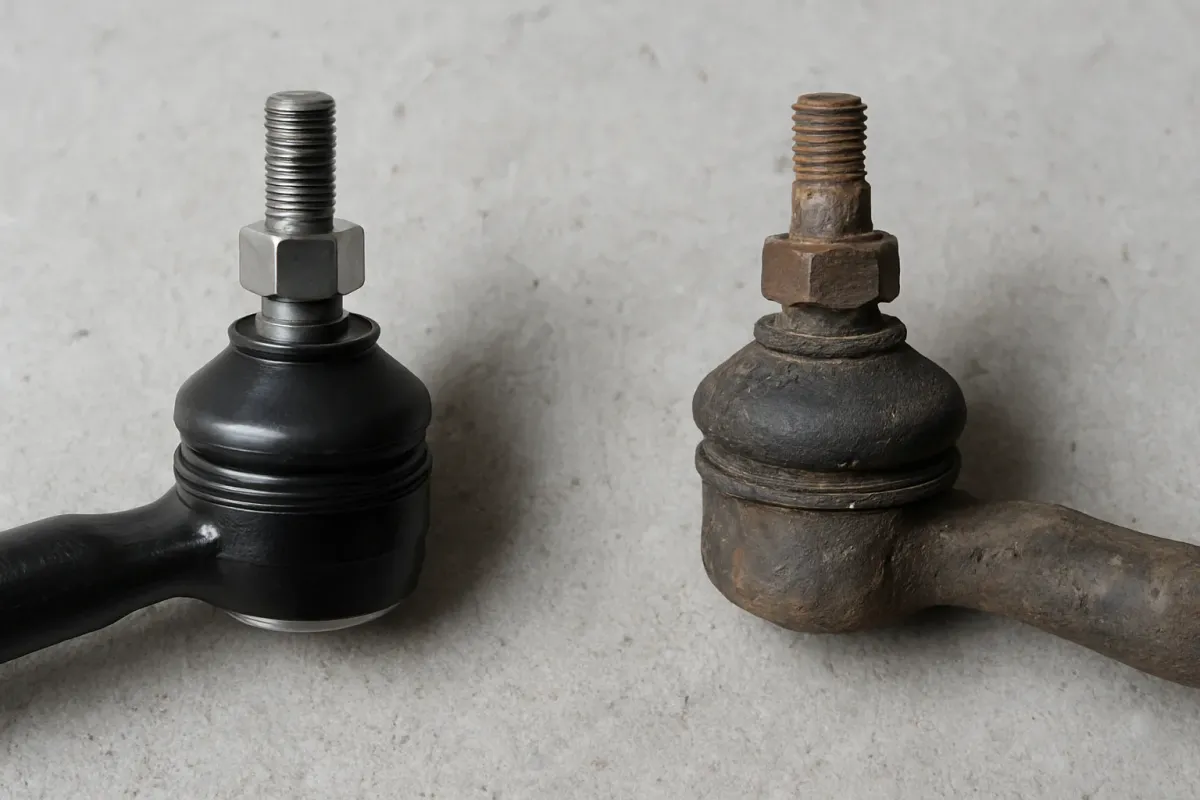
Tie rods and tie rod ends
Tie rods connect the steering gear and the steering knuckle. Tie rod ends with a ball joint transmit the steering movement and allow suspension travel. Play in tie rod ends leads to:
- steering play around the center position
- clunking on cobblestones
- saw-tooth or angled wear on the tires
After replacement a wheel alignment must definitely be done, because the toe will change. In the category Tie rods & tie rod ends you’ll find vehicle-specific parts.
Wheel bearings, wheel hubs and bushings
Many newer US vehicles have preassembled wheel hubs with integrated wheel bearing and often also an ABS sensor, e.g.:
- wheel hub with bearing front for Cadillac Escalade / Chevrolet Avalanche 2007 - 2014
- wheel hub with bearing front for Chevrolet Silverado / Suburban / Tahoe 2007 - 2014
- wheel hub with bearing front for Chevrolet Corvette / Cadillac XLR 1997 - 2008
The advantage: no setting of bearing clearance, but the complete module is replaced. Symptoms of defective bearings are grinding noises increasing with speed, vibrations and sometimes ABS errors.
Rubber bushings in control arms and on the rear axle age due to oil, salt and load. Under Wheel bearings, hubs & bushings you’ll find suitable components.
Leaf and coil springs
Leaf springs are widespread in US pickups and vans, coil springs more in cars and SUVs. Both can fatigue, causing the vehicle to sit lower or lean to one side. Severe rust on leaf springs carries a risk of breakage.
When replacing, always renew both springs on the same axle. In the category Leaf & coil springs vehicle-specific sets are listed.
Finding the right parts for your US car
US vehicles often have different suspension components depending on year, engine, drive (2WD/4WD/AWD) and special equipment. To ensure parts really fit, you should have the following information ready:
- exact model designation and year (observe model year)
- engine and drive type (e.g. 5.7L 4x4, RWD)
- body variant (Crew Cab, Extended Cab, SUV, Coupe etc.)
- if necessary VIN (vehicle identification number) for exact assignment
Pay attention to notes in the item description such as “only RWD”, “only with HD suspension”, “only with a certain brake system” or axle variant. An example is the wheel hub with bearing front / rear for Lincoln MKT / MKS 2010 - 2019, which can be used front or rear depending on equipment.
Removal and installation: procedure and notes
Preparation and safety
- Park the vehicle on level ground, select gear or P, apply the parking brake.
- Loosen the lug nuts slightly before lifting.
- Lift the vehicle with a suitable jack at the designated points and secure with jack stands.
- Never work under a vehicle supported only by a jack.
- Keep service documents for the vehicle ready (torque specs, disassembly instructions).
Replacing shock absorbers / strut (basic principle)
The exact procedure differs by vehicle, but in general:
- Remove the wheel and clean the area.
- At the strut, release the top mount fastenings (usually accessible in the engine bay / trunk).
- At the bottom, unbolt the damper from the steering knuckle or its mounting.
- Remove the damper/strut; for a strut: secure the spring with a suitable spring compressor and transfer the strut mount if it is not new.
- Install the new unit; tighten fastenings to the prescribed torque only when the suspension is loaded.
Always take torque values from the vehicle-specific documentation – do not tighten by feel.
Replacing control arms and ball joints
Work on control arms varies in effort depending on axle design. Typical procedure:
- Wheel off, support the steering knuckle if necessary with a transmission jack or support.
- Separate the ball joint from the steering knuckle (remove cotter pin, loosen nut, use a puller/press).
- Unbolt the control arm from the frame or subframe and remove it.
- Install the new control arm with new bolts/bushings, but only tighten the bushing bolts by hand.
- Lower the vehicle onto its wheels or raise the axle with a transmission jack to ride height, then torque the bushing bolts to the specified torque (to avoid preloading the rubber).
After work on load-bearing and guiding elements you should always have a professional wheel alignment carried out.
Replacing tie rod ends
For the hobby mechanic it is important to keep the previous tie length as close as possible so you can at least drive to the workshop:
- Mark the thread and locknut before disassembly (e.g. with a paint marker).
- Loosen the locknut, unscrew the tie rod end from the tie rod and separate the taper from the steering knuckle.
- Screw the new tie rod end on so that marking and thread distance roughly match.
- Secure the locknut, renew the cotter pin on the taper bolt.
Then have the alignment set promptly to avoid tire wear and poor handling.
Replacing wheel hub with bearing (module design)
With modules as on the Explorer, Silverado or Escalade the replacement is usually quite doable:
- Remove wheel and brake caliper with bracket, hang up the caliper (do not let it hang on the hose).
- Remove the brake disc, if applicable remove retaining screws.
- Disconnect the ABS sensor connector and note the cable routing.
- Loosen the axle nut of the drive shaft (on 4x4/AWD) and press the shaft out of the hub.
- Loosen the rear mounting bolts of the hub from the steering knuckle, pull off the hub (corrosion can hold it; penetrating oil and a rubber mallet help).
- Thoroughly clean the contact surfaces on the steering knuckle.
- Install the new hub, torque the bolts to the values specified in the documentation, tighten the axle nut correctly.
- Route and connect the ABS cable, reassemble the brake.
The correct torque values for wheel bearing bolts and the axle nut are particularly important. These must be taken from the manufacturer’s data, because too low or too high torques can damage the bearing.
Check after installation and test drive
After suspension work you should:
- visually inspect all fastenings (markings with a paint stick are helpful)
- move the vehicle on the lift through its travel and listen for unusual noises
- check tire pressure, observe tire wear
- perform a cautious test drive: brakes, slow and then faster turns, bumps
If the vehicle pulls after the repair, the steering is off-center or clunking noises occur, do not continue driving — check the work or have an alignment performed.
Common mistakes when modifying suspension
- Bushings tightened in the extended state: leads to stressed rubber mounting and premature wear.
- No wheel alignment: new parts but poor handling and heavy tire wear.
- Wrong part variant: RWD parts on 4x4, wrong bolt pattern or wrong ABS sensor type on wheel hubs.
- Reusing old torque-to-yield bolts: where the manufacturer prescribes new bolts, used stretch bolts can fail.
- Working without a torque wrench: over- or under-tightened bolts on suspension and wheel bearings are a safety risk.
Frequently asked questions
When should shock absorbers on my US car be replaced?
There is no fixed mileage because usage and load vary greatly. Indicators are prolonged after-oscillation of the vehicle after bumps, unstable straight-line behavior, noticeably longer braking distances and uneven tire wear. Visible oil traces on the damper are a clear sign to replace. If in doubt, have a suspension test performed on a test rig.
Can I replace only one control arm or shock absorber per axle?
Technically a one-sided replacement is often possible, but pairwise replacement per axle is recommended. Only then is the left/right behavior comparable. Especially with shock absorbers, differing damping forces can negatively affect stability during braking and in corners.
Is a self-adjusted tie rod end without wheel alignment sufficient?
The rough adjustment by thread turns or marking is only enough to drive to the workshop. For correct toe values, good handling and even tire wear, a professional wheel alignment after work on tie rods, control arms or struts is strongly recommended.