Rear spoilers & wings for US-Cars: selection and installation
Rear spoilers for US cars: what to check before buying. Compare vehicle fitment, kit contents and relevant products.
Function of rear spoilers and rear wings on the US-Car
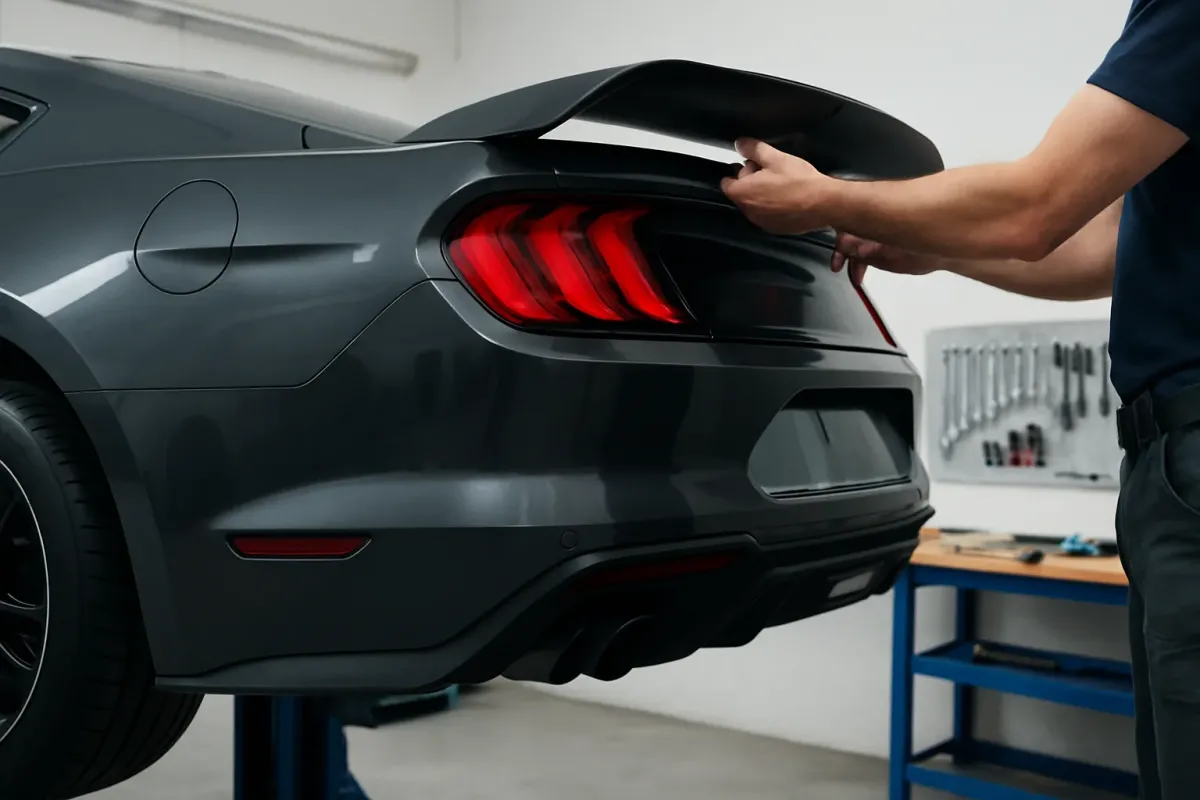
Rear spoilers and wings are not just cosmetic tuning. They affect the handling of your US-Car, especially at higher speeds:
- Reduced lift on the rear axle, more stable behavior at highway speeds.
- Better straight-line stability and more reserves during lane changes.
- Targeted airflow management over the trunk lid or roof, depending on the design.
In everyday use the visual aspect predominates for many US-Cars, but the aerodynamic effect should not be underestimated — especially for vehicles with high power output such as Camaro, Mustang, Challenger or Corvette.
Types of rear spoilers and wings
Basically you can distinguish between three constructions:
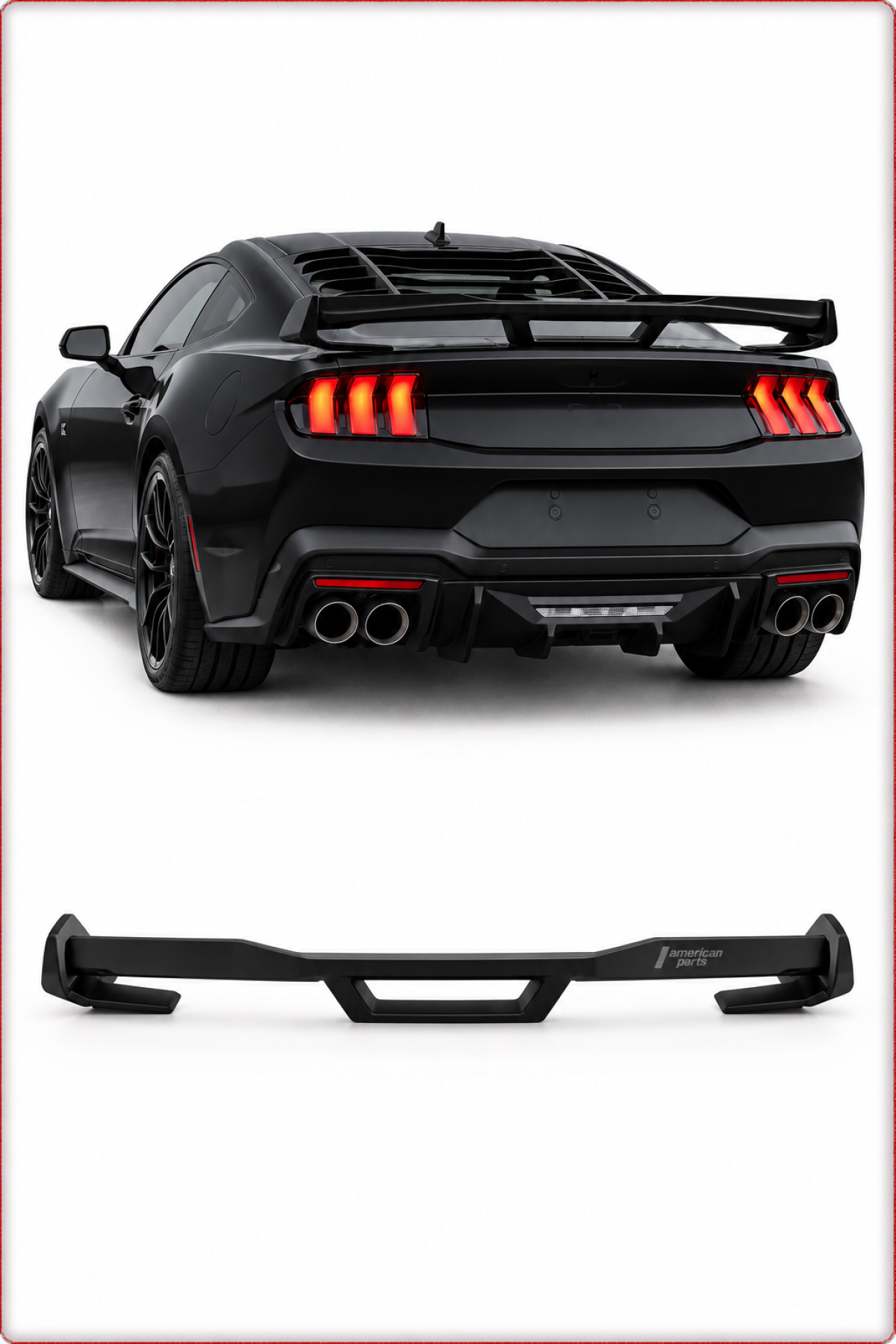
- Lip or edge spoilers: flat, sit directly on the trunk lid edge, usually bonded or fixed with a few screws.
- Raised rear spoilers: classic spoiler shape, often with side feet, usually bolted.
- Rear wings / high wing: taller wings with pronounced supports, stronger aerodynamic effect, almost always bolted.
An example of a high wing is the Rear spoiler for Chevrolet Corvette 2020–2026 High Wing / gloss black, which protrudes clearly beyond the rear profile.
Materials and finishes
In the aftermarket for US-Cars three materials have become established in particular:
- ABS plastic: the most common variant, good ratio of weight, strength and workability. Can be sanded and painted.
- GFRP (glass-fiber reinforced plastic): relatively stiff, but often somewhat heavier and requires more post-processing before painting.
- Carbon: light and stiff, rather in the high-performance segment. Mounting principles are similar though.
Many spoilers are already delivered in gloss black. Then painting is often unnecessary if the look matches your vehicle, for example with the Rear spoiler for Dodge Challenger 2008–2023 Hellcat style / TÜV gloss black.
Selection criteria: What fits your US-Car?
Vehicle-specific vs. universal
For current US models vehicle-specific spoilers are often offered. Examples:
- Rear spoiler for Chevrolet Camaro 2016–2023 ZL1/1LE style / TÜV
- Rear spoiler for Ford Mustang 2015–2023 GT500 style tuning / TÜV
- Rear spoiler / roof spoiler for Dodge Durango 2011–2021 SRT 21+ style / TÜV
Such parts follow the original body lines and generally fit better than universal spoilers. The hole spacings and contours are tailored to your model, which significantly simplifies installation.
With or without existing factory spoiler
Be sure to note whether your vehicle has a factory-installed rear spoiler:
- Vehicles without a spoiler: Drilling into the trunk lid is often necessary. Check from the inside whether reinforcements are present.
- Vehicles with a factory spoiler: Many aftermarket spoilers use the existing mounting points, others require new drillings.
For the Camaro 2016–2023 there are e.g. variants that replicate the original ZL1/1LE look, like the Rear spoiler for Chevrolet Camaro 2016–2023 ZL1/1LE style / gloss black.
TÜV and approval
In Germany approval is an important issue. Many spoilers are offered with valid documents for registration (e.g. with TÜV report or comparable documentation). Without suitable paperwork, registration can be complex or impossible.
Check before purchase:
- Which documents are included (component certificate, ABE, material certificate)?
- Are there conditions for installation (e.g. only in combination with certain wheels/tires)?
- Does the certificate apply to your model year and body variant (coupe, convertible, SUV)?
Mounting methods: bonding, bolting or both?
The attachment depends on spoiler design, material and vehicle. Three methods are common:
1. Pure adhesive mounting
Usually used for flat lip or edge spoilers. Basis is a high-quality double-sided automotive body tape plus possibly additional body adhesive.
- No visible drill holes.
- Removal is possible again with effort (cleaning the adhesive surface).
- Not suitable for large, high-profile wings.
2. Bolted with additional bonding
Standard for larger spoilers and wings. The bolts take the main load, tape or sealant is used for sealing and to relieve the fasteners.
- High stability even at high speeds.
- Requires precise drilling in the trunk lid or roof.
- Holes remain after removal and must be properly sealed.
3. Roof spoilers
Roof spoilers, for example on the Durango, are often mounted with a combination of bonding and possibly hidden bolting. Here pay special attention to sealing against water ingress, as wiring harnesses for the tailgate, camera or wiper often run nearby.
Tools and preparation
Depending on the spoiler type you typically need:
- Ratchet with appropriate sockets and possibly Torx bits
- Drill or cordless drill/driver with metal drill bits
- Tape measure, masking tape, felt-tip pen for positioning
- Degreaser (silicone remover, isopropanol) for adhesive surfaces
- Plastic wedges to remove trim
- Body sealant and possibly corrosion protection for drilled holes
Exact details on tool sizes (e.g. wrench sizes, Torx sizes) and torque specifications can be found in the workshop literature or the repair manual for your vehicle.
Installation steps at a glance
The concrete procedure varies by model and spoiler. The following steps give you a general workflow for bolted spoilers, as commonly used for Mustang, Camaro or Challenger.
1. Remove interior trim
- Open the trunk lid and remove the interior trim or trunk lid trim.
- Use plastic wedges to release clips to avoid damage.
- Carefully remove any insulation mats if present.
2. Remove old spoiler (if present)
- Remove the mounting bolts from the inside.
- Carefully lift the spoiler. If necessary, warm the adhesive with a heat gun.
- Remove old adhesive residue from the trunk lid with a plastic scraper and then clean with degreaser.
3. Determine position of the new spoiler
- Place the spoiler without adhesive first and roughly align it.
- Use a tape measure left and right to set equal distances to the trunk lid edge.
- Mark the final position on the paint with tape markings so you can work quickly and securely during the actual installation.
4. Drilling (for bolted spoilers)
This step requires special care. A wrongly placed hole is hardly correctable later.
- Spoiler drilling templates may be included. If present, use exactly according to the instructions.
- Before drilling check whether cables, reinforcements or double panels are located behind the drilling point.
- Use a small pilot drill and then drill to the final diameter – exact sizes are given in the spoiler's installation instructions.
- Deburr sharp edges and apply corrosion protection.
The tightening torques required for your vehicle's mounting bolts are listed in the vehicle-specific documentation or the workshop manual. You should definitely look them up there.
5. Mounting the spoiler
- Clean adhesive surfaces (spoiler and paint) with degreaser and let dry.
- Apply double-sided automotive body tape to the spoiler, but initially only peel back the protective film slightly at the ends.
- Place the spoiler using the markings, insert bolts and only tighten lightly.
- When everything is correctly aligned, peel off the tape backing bit by bit and press the spoiler down evenly.
- Gradually tighten the bolts to the torque specified in the vehicle documentation.
6. Sealing and check
- From the inside seal all drilled holes with sealant to prevent corrosion and water ingress.
- Reinstall interior trim, check wiring routes.
- Function test the trunk lid, lighting and, if applicable, the rearview camera.
- Check the fastenings again after a few hundred kilometers.
Specials for Gurney flaps and adjustable wings
Some spoilers offer additional attachments such as Gurney flaps, for example the Rear spoiler + Gurney flap for Ford Mustang 2015–2023 GT500 style / TÜV.
Important here:
- Gurney flaps increase downforce, but can also increase aerodynamic drag.
- Mounting is usually done with small screws or additional adhesive – follow the instructions precisely.
- Check whether the combination of spoiler and Gurney flap is covered by the certificate.
Tips for everyday use and care
- Repainting: If an unpainted or primed spoiler is delivered, painting should always be done before installation.
- Car wash: Some car washes with rotating brushes can be problematic for freshly installed or very delicate spoilers. Observe the notes in the certificate or installation instructions.
- Cleaning: Standard car care products are generally unproblematic. For carbon or high-gloss surfaces avoid abrasive polishes.
- Inspection: Especially after winter or frequent highway drives check all fastening points for secure fit.
Overview: Popular rear spoilers for US-Cars
A selection of vehicle-specific spoilers and wings can be found in the category Rear spoilers & wings. Typical examples:
| Vehicle | Style | Feature |
|---|---|---|
| Chevrolet Camaro 2016–2023 | ZL1/1LE style | sporty look, available with TÜV documents |
| Ford Mustang 2015–2023 | GT Performance / GT500 style | various performance and appearance levels, partly with Gurney flap |
| Dodge Challenger 2008–2023 | Hellcat style | distinctive muscle-car line, gloss black finish available |
| Chevrolet Corvette 2020–2026 | High Wing | significantly raised rear wing, track-oriented look |
| Dodge Durango 2011–2021 | SRT 21+ style | roof spoiler with a sporty touch for SUVs |
Common mistakes in selection and installation
- Wrong model/year chosen: always match exactly with the vehicle registration document and the description.
- Not reading the certificate: leads to problems later during approval.
- Unclean preparation of adhesive surfaces: reduces adhesion and can lead to detachment.
- Drilling without checking the rear side: risk of damaging cables or reinforcements.
- Lack of corrosion protection: always protect drilled holes against rust.
Frequently asked questions
Do I need TÜV approval for every rear spoiler?
For most retrofitted rear spoilers in Germany an inspection is required. Whether a component certificate or other documents are available is stated in the product description and the papers supplied. You can get details from your inspection organization and in the vehicle documents.
Can I simply reuse the original mounting holes?
If the new spoiler is explicitly intended for your model and for vehicles with a factory spoiler, the existing holes are often used. If this is not clearly described, you should check the spoiler's installation instructions carefully and, if in doubt, consult a repair manual or the bodywork documentation of your vehicle.
What torque specifications apply for the spoiler bolts?
The torque specifications are vehicle-specific and sometimes also depend on the type of fastening (sheet nut, screw into a threaded insert, etc.). Since these values are not uniform, you should always look them up in the official vehicle documentation or the workshop manual for your US-Car.