Hoods for US cars: selection, fit and installation
Hoods for US cars: what to check before buying. Compare vehicle fitment, kit contents and relevant products.
Basics: function and construction of the hood
The hood protects the engine bay from weather, dirt and stone chips while at the same time influencing the appearance, aerodynamics and noise characteristics of a US car. Depending on the model, it may also be designed with crash behaviour and pedestrian protection in mind. When replacing or modifying it, you should therefore choose not only based on looks but also on fit and quality.
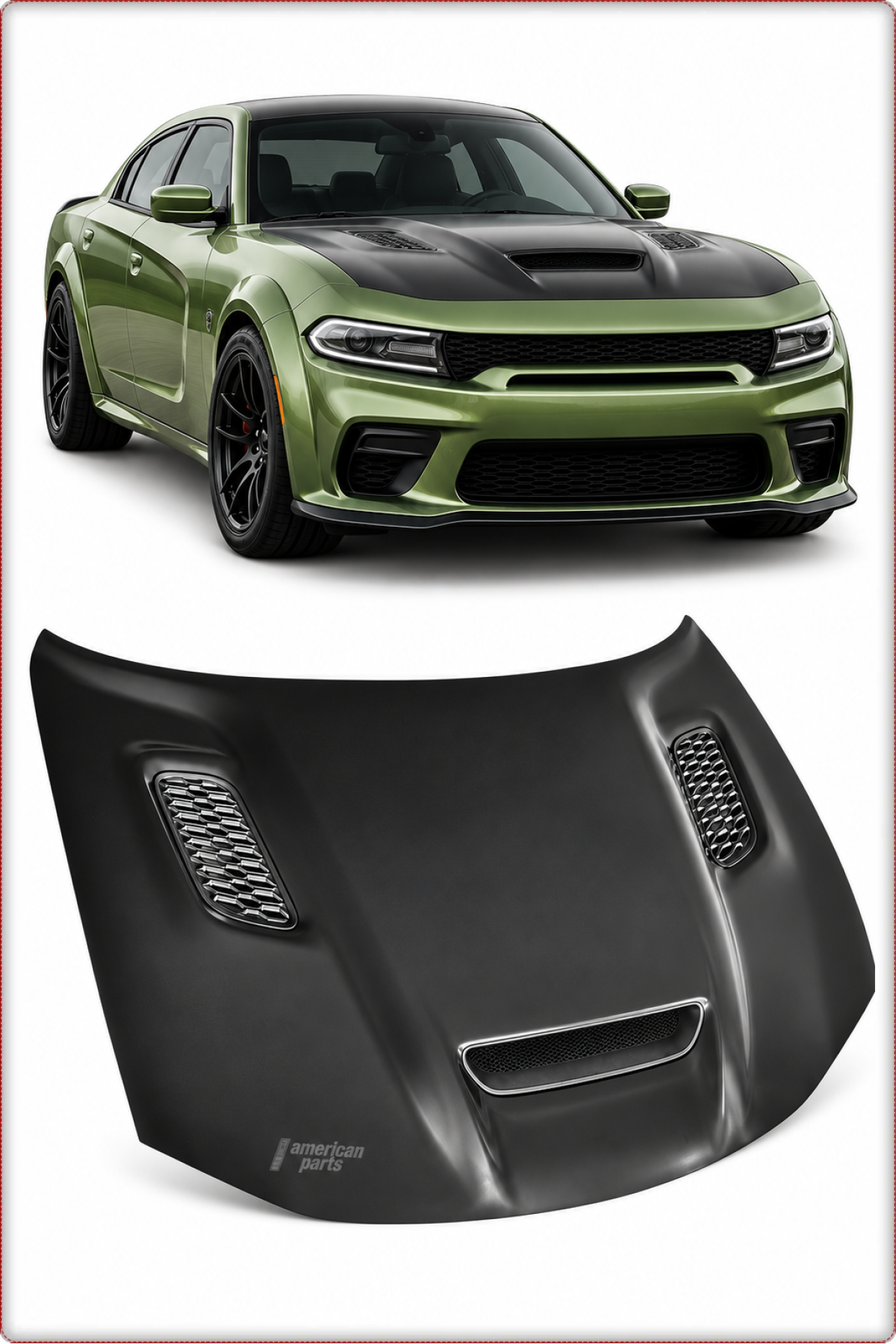
Typical designs are smooth hoods, hoods with air intakes (Ram-Air, Powerdome, Heat-Extractor) as well as lightweight aluminium hoods. Many aftermarket hoods follow the design of sportier variants, such as Trackhawk-, ZL1- or Shelby-style.
Materials: steel, aluminium and special solutions
Two materials are predominantly used on US vehicles:
Steel hoods
Steel sheet is standard on many pickups and older models. Advantages are high robustness and good repairability (panel beating, welding, tinning). The additional weight, however, can make handling the hood more difficult and place higher demands on gas struts or springs.
An example of a steel aftermarket hood is a Ram-Air hood for the Ford F-150 2015–2020: Steel hood for Ford F-150 2015–2020 Ram Air style. More specialised designs such as Shelby-Baja looks are also available in steel: Steel hood for Ford F-150 2015–2020 Shelby Baja Edition.
Aluminium hoods
Aluminium is used especially on newer US cars to save weight. This makes handling during installation easier and can improve the vehicle's centre of gravity. Aluminium deforms differently than steel in an accident and is more demanding to repair, but is more resistant to corrosion.
Typical examples are aluminium hoods for Dodge Durango, RAM, Camaro or Jeep Grand Cherokee. You can find such hoods in the hoods category: Hoods at american-parts.eu.
An aluminium hood in a sporty style would be, for example, the Aluminium hood for Chevrolet Camaro 2016–2024 LT/RS/SS ZL1 style or a Trackhawk/SRT look for the Grand Cherokee: Aluminium hood for Jeep Grand Cherokee 2014–2021 Trackhawk SRT.
Choosing the right hood
Model, model year and body variant
The most important basis is the exact vehicle identification. On US models, hood shape, fastenings and front termination often change within just a few facelifts.
- Manufacturer, model and exact type designation
- Model year according to the VIN (not just first registration)
- Body style (e.g. Crew Cab, Regular Cab, coupe, SUV)
- Engine variant, if the hood requires special air inlets or protrusions
Examples of precise matching in the aftermarket are, for instance:
- Aluminium hood Dodge Durango 2014–2024, 2021+ style
- Aluminium hood Dodge RAM 1500 2010–2018 Sport Rebel versus 2019–2024 Sport Rebel
Here you can see that even within one model different hoods are required (e.g. RAM 1500 before and after a model change).
Original design vs. sport or off‑road style
Depending on intended use you can choose between near‑factory hoods and designs in a performance or off‑road look:
- Factory-style: visually close to the original, ideal for repair after accident damage or rust.
- Performance: additional air inlets, power domes, heat extractors. Examples are ZL1- or Trackhawk-styles.
- Offroad/Truck: hoods with pronounced air channels or Ram-Air elements, e.g. Shelby‑Baja‑like hoods.
Important: if air inlets are intended to be functional, ensure that water drainage and airflow to the intake system can be implemented sensibly. Improvised solutions can lead to water ingress in the air filter housing or increased temperatures in the engine bay.
Fit, attachment and accessories
A hood must match the vehicle exactly at several points:
- Hinge mounting points at the front or rear (depending on model)
- Mounting for the hood latch or latch striker
- Edge alignment with fenders, bumper and front fascia
- Cutouts for washer nozzles and struts
- Mounting for insulation pad and heat shielding in the area of exhaust manifolds/turbochargers
Many aftermarket hoods use the original mounting points, nevertheless fine adjustments to hinges and latch are almost always necessary during installation.
Preparation of the new hood
Blank part, primer and corrosion protection
Aftermarket hoods are usually delivered primed. Before painting you should:
- Fit the hood temporarily, adjust gap dimensions and set the hood latch roughly.
- Check all holes and mountings (latch, hinges, struts, nozzles).
- Mark any additional holes required and perform them while the hood is removed.
- Prepare primer and transitions according to the paint shop's specifications (scuff, degrease).
If in doubt, have the final paint preparation carried out by a specialist workshop, especially for aluminium, to avoid galvanic corrosion and paint problems.
Transfer of attached parts
You usually need to transfer the following from the original part:
- Hood latch or locking elements
- Hinges, unless included in the delivery
- Gas struts or support rods
- Insulation pads and heat shields
- Washer nozzles, hoses and if applicable hose clips
- Plastic clips and underside covers
Use new clips if the old ones are damaged during removal. When converting, check whether the new hood is approved for the existing gas struts, especially if it is significantly lighter or heavier than the production hood.
Installation: step‑by‑step overview
Required equipment
For installation in your own garage you will generally need:
- Socket and ring spanner set (imperial and metric, depending on vehicle)
- Torque wrench (consult the manufacturer's documentation for tightening torques)
- Screwdrivers, plastic levers for clips
- Marker pen or tape to mark hinge positions
- At least one other person to hold and align the hood
- Soft padding/blankets to protect hood and fenders
Removal of the old hood
- Park the vehicle on level ground, switch off the engine, turn off ignition.
- Open the hood and secure it with the standard prop or an additional support.
- Disconnect and secure washer hoses and any electrical connections (e.g. hood contact).
- Unfasten gas struts or support rods from the hood, but leave them attached to the vehicle.
- With two people, unbolt the hinge fastenings. Beforehand mark the position of the hinges on the hood to have a rough baseline setting for the new hood.
- Carefully lift off the hood and place it on a soft surface.
Check the hinges for play and damage. Excessive play can later lead to rattling and uneven gaps.
Fitting and aligning the new hood
- With two people place the new hood and tighten the hinge bolts only finger‑tight.
- Carefully close the hood and check gap dimensions to the fenders and bumper.
- Open the hood again and make minimal corrections to the hinge positions. Repeat this process until the gaps are even and the hood neither protrudes nor rubs.
- Install or transfer the hood latch and align it roughly in the original position.
- Close the hood and check that it latches securely. If necessary, adjust the height and position of the latch striker according to the manufacturer's specifications.
- Install gas struts or support rods and test their function. The hood must fully open and hold securely in the open position.
- Reconnect washer nozzles, hoses and any cables and check for leaks.
All fasteners should afterwards be tightened to the specified torque. Please obtain these values from your vehicle's technical documentation or a workshop‑specific repair manual.
Particulars for sporty and off‑road hoods
Hoods with air inlets or vents
Ram‑Air or vent openings change the airflow in the engine bay. Pay attention to:
- Sufficient water drainage so that no water runs into electrics or the air filter housing.
- Heat protection in the area of turbochargers, exhaust manifolds or forced induction systems.
- No contact with moving parts (e.g. engine cover) on the underside of the hood.
If inlets are made "functional" afterwards (cutting out blanking plates etc.), this can lead to uncontrolled water and dirt ingress. Such modifications should only be done with a technical concept and suitable drainage routes or hoses.
Hoods for tuning and performance models
With performance‑oriented hoods like ZL1‑ or GTD‑like designs, for example for Camaro or Mustang, ensure there is sufficient clearance for air filters, superchargers or strut tower braces. Before final painting, check that all components in the engine bay have enough space.
An example from the aftermarket segment is an aluminium hood in GTD style for a current Mustang: Aluminium hood for Ford Mustang 2024–2026 GTD style. Pickup hoods in Rebel or Sport looks, e.g. for the RAM 1500 of older and newer years, follow the same scheme.
Legal aspects and safety
With externally modified hoods (additional openings, different contours) there may in some countries be registration obligations, inspections or requirements regarding pedestrian protection. Check the applicable regulations with the responsible inspection authority before the conversion.
Key safety aspects during installation:
- The hood must latch securely at all times and must not be able to open while driving.
- The hood latch emergency release cable must not jam or be excessively stiff.
- Gas struts should not bottom out or be undersized.
- No sharp edges or loose trim parts on the underside of the hood.
Care and maintenance of the hood
Even after the conversion the hood should be regularly inspected:
- Check gap dimensions after a few hundred kilometres, readjust if necessary.
- Check the fastenings of hinges and hood latch.
- Clean water drains and air channels, especially on hoods with inlets.
- Inspect for beginning corrosion at cut edges and drilled holes, especially on steel hoods.
For aluminium hoods it is important to seal paint damage promptly to avoid galvanic corrosion with adjacent steel parts.
Frequently asked questions
Does an aftermarket hood always fit plug‑and‑play without adjustments?
As a rule, gap dimensions and latch position must be adjusted. Small corrections to hinges and latch are normal. Drilling or reworking should only be done after consultation with the manufacturer and preferably before painting.
Can I replace a steel hood with an aluminium hood without changing the gas struts?
Not necessarily, but it is possible. Whether existing struts can continue to be used depends on their design and the weight change. After installation check whether the hood is held open securely and can still be closed easily. If in doubt, consult the manufacturer's information or a specialist workshop.
Where can I find the correct torque values for hinges and hood latch?
Use only the specifications from the official vehicle documentation, a brand‑specific repair manual or a professional workshop information system. Do not guess torque values to avoid warping, loose connections or damage to the hood.