Brakes & Brake Parts for Dodge Ram 1500: Selection and Installation
RAM 1500 brakes: what to check before buying. Compare vehicle fitment, kit contents and relevant products.
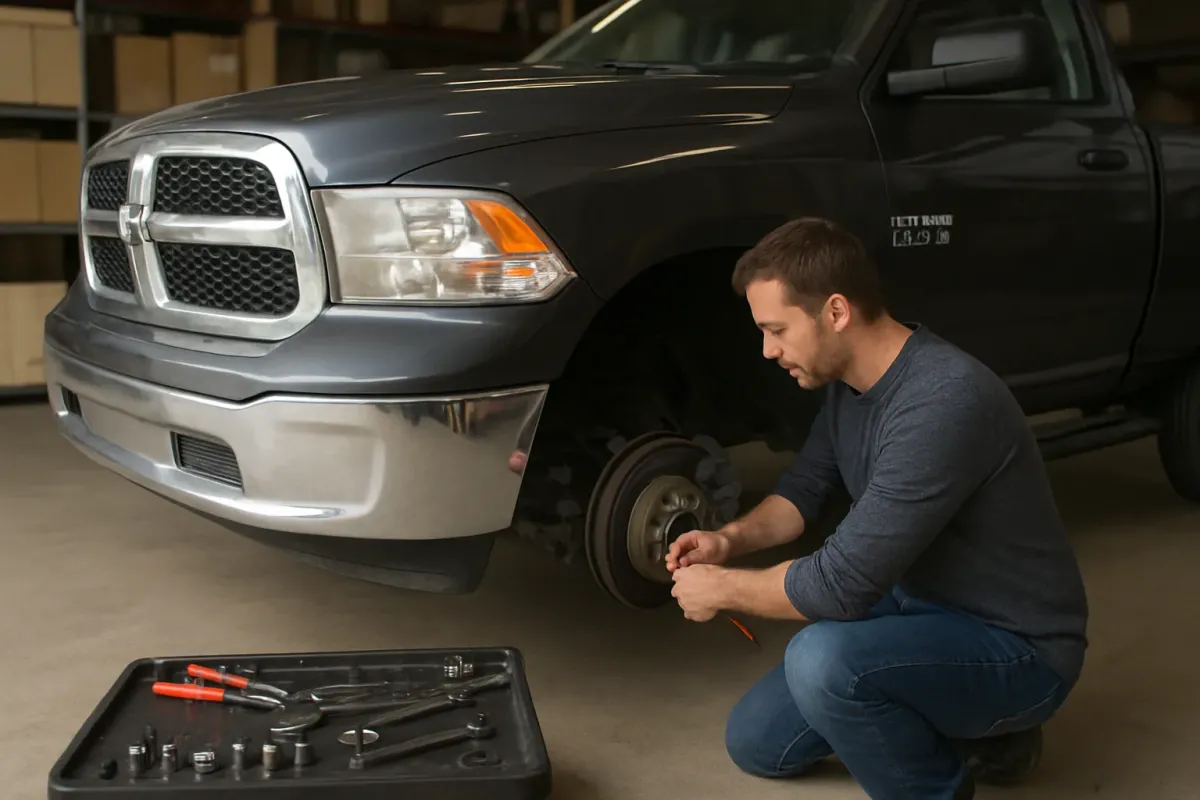
Overview: Brakes on the Dodge Ram 1500
The brakes on the Dodge Ram 1500 are heavily stressed: high vehicle weight, trailer use and large wheels lead to high thermal and mechanical loads. Therefore, correct selection and professional installation of brake rotors, brake pads and other brake parts are critical for safety and vehicle behavior.
This guide refers exclusively to the Dodge Ram 1500 and is aimed at mechanics who want to perform maintenance and parts replacement themselves.
Finding suitable brake parts for the Dodge Ram 1500
The brake system of the Dodge Ram 1500 varies depending on model year, equipment variant and axle load. For correct parts selection you should always check the following information:
- Vehicle registration / vehicle papers (type, year of manufacture, axle load)
- Vehicle identification number (VIN)
- Front axle / rear axle configuration (e.g. disc/drum for the parking brake)
- Number of wheel studs and rotor diameter
In the category Bremsen & Bremsenteile you can narrow down suitable components specifically for the Dodge Ram 1500 via the vehicle selector. Pay attention to the exact model description and any listed OE numbers for each item.
Important components of the brake system on the Dodge Ram 1500
Brake rotors
The brake rotors on the Dodge Ram 1500 are highly stressed wear items. Depending on use there are different designs:
- Close-to-production, solid or vented rotors – sufficient for normal road use.
- Drilled or slotted rotors – can offer advantages in wet conditions and heat stress, e.g. for frequent trailer use or mountain driving.
- Coated rotors – usually provide better corrosion protection around the hub and edge areas.
Examples of vehicle-specific sets are e.g. brake rotors with pads rear for Dodge Ram 1500 2002–2021 or coated brake rotors with pads front for Ram 1500 DT. Always check compatibility with your specific vehicle.
Brake pads
Brake pads are matched to the rotors and the brake calipers. Differences exist in pad material and shape:
- Organic / semi-metallic pads – often close to factory spec, balanced between braking performance and comfort.
- Ceramic or low-dust pads – aimed at less brake dust and more consistent braking behavior.
Examples: front brake pads for Dodge Ram 1500 Pickup specific model years or front brake pads for Ram 1500 DT. Keep your VIN ready to avoid mix-ups.
Brake calipers and brackets
Worn or seized brake calipers on the Dodge Ram 1500 quickly lead to uneven braking, unevenly worn pads or overheating. When replacing, check:
- Free movement of the guide pins
- Integrity of the boots (dust boots, piston seals)
- Sealing of the pistons
Replacements can be found in the category Bremssättel & -halterungen. Pay attention to the correct side (left/right), front or rear axle and design.
Brake drums and parking brake shoes
Many Dodge Ram 1500 variants use a disc brake for the service brake at the rear axle and a drum-in-disc solution for the parking brake. Here the brake shoes and springs wear over time.
An example is a spring kit and brake shoes for the rear parking brake for certain Dodge Ram 1500 models, as available via corresponding brake shoe sets. Always check whether your model (series, year of manufacture) is named in the description.
Complete kits vs. individual parts
For many Dodge Ram 1500 configurations complete kits are available, e.g. front and rear axle including rotors and pads. Typical advantages of complete kits:
- All parts are matched to each other.
- Front and rear axle can be overhauled in one work session.
- Often mounting hardware (clips, springs, bolts) is included.
Examples can be found in the category Bremsscheiben or directly at drilled brake rotors with pads front and rear for certain Dodge Ram 1500 models. If you only replace individual components, the existing parts must match the other axle or side (material, rotor thickness, pad compound).
Preparation: Safety and tools
You should only work on the brake system if you are confident handling suspension, fasteners and brakes. Always follow the instructions in the workshop manual for your Dodge Ram 1500.
Typically you will need:
- Stable jack points and axle stands with sufficient load capacity
- Lug wrench or impact wrench for lug nuts
- Sockets, box-end wrenches and preferably a torque wrench
- Caliper piston retractor or suitable pliers/press for brake pistons
- Rotor holder or wheel nut to fix the rotor during installation
- Wire or hook to hang calipers (do not hang on the hose)
- Brake cleaner, copper or ceramic paste (only applied at approved points)
The exact torque specifications for caliper bracket bolts, lug nuts and other fastenings can be found only in the Dodge documentation or a workshop manual specific to the vehicle. Do not estimate.
Installation notes: Brake rotors and brake pads on the Dodge Ram 1500
1. Secure the vehicle
- Place the vehicle on a solid, level surface.
- Release the parking brake, select a gear or set to Park.
- Support and jack the front or rear axle as required.
- Remove the wheels on the axle to be worked on.
2. Remove caliper and bracket
- Loosen caliper fastenings and carefully remove the caliper.
- Hang the caliper from the chassis with wire to avoid stressing the brake hose.
- Remove brake pads and, if applicable, anti-rattle plates/clips.
- If necessary, unbolt the caliper bracket (usually required for rotor replacement).
3. Remove the old rotor
- Remove any retaining screws of the rotor.
- Use penetrating oil on the hub and rotor mounting.
- Pull off the rotor, if necessary free it with a rubber mallet.
- Thoroughly clean the wheel hub from rust and dirt (wire brush, abrasive pad).
A clean and flat contact surface is important to avoid runout and vibrations on your Dodge Ram 1500.
4. Install the new rotor
- Degrease the new rotor before installation with brake cleaner (remove shipping oil).
- Place the rotor and, if needed, temporarily secure it with one lug nut.
- Tighten retaining screws (if present) to the torque specified in the vehicle documentation.
5. Retract brake piston and install new pads
- Carefully push back the brake piston according to the design (apply the tool squarely, do not damage the boot).
- Lightly treat the pad contact surfaces in the caliper bracket with suitable paste (do not apply paste to friction surfaces of pad or rotor).
- Install new brake pads and position them correctly (observe inner/outer pad orientation).
- Mount the caliper and tighten to the specified torque values (see workshop manual).
6. Final tasks
- Mount wheels and tighten lug nuts to the torque specified in the manual.
- Check brake fluid level.
- Before driving, press the brake pedal several times with the vehicle stationary until a firm pedal point is present.
Installation notes: Parking brake and rear brake shoes
When replacing the parking brake shoes on the Dodge Ram 1500 the following procedure is common (schematic, details vary by version):
- Remove the rear wheel and rotor to gain access to the drum-in-disc assembly.
- Document the arrangement of springs, retaining clips and parking brake shoes (take a photo).
- Remove old shoes and springs.
- Clean contact surfaces and lightly lubricate where specified (only at designated points).
- Install new brake shoes and springs as specified.
- Adjust the parking brake cable and adjuster according to the workshop manual.
When in doubt always use an official repair manual for the Dodge Ram 1500, as the exact spring routing and adjuster position are important for correct parking brake function.
Bedding in new brakes on the Dodge Ram 1500
After changing rotors and/or pads, correct bedding-in is important so that pads and rotors mate optimally and no hot spots develop.
- Do not perform full-force stops from high speed in the first 200–300 km unless absolutely necessary.
- Perform repeated moderate decelerations from mid-range speeds so the system builds temperature evenly.
- Allow short cooling phases between heavier stops.
More detailed recommendations can be taken from the instructions of the pad or rotor manufacturer.
Maintenance and inspection of the brake system
To keep the brake system of your Dodge Ram 1500 safe over time, you should regularly check:
- Remaining pad thickness on front and rear axle
- Grooves, cracks or bluing on the rotors
- Sealing and condition of brake hoses
- Even braking effect (no pulling to one side)
- Function of the parking brake (holding on inclines, number of click positions on the lever/button)
Replacement parts for these tasks can be found grouped under Bremsen & Bremsenteile. For special parts or sensors, check the subcategory Sonstige Bremsenteile.
Frequently asked questions
Can I replace rotors and pads on only one axle of the Dodge Ram 1500?
Technically, replacement on only one axle is possible, however left and right on the same axle should always be renewed as a pair. Differently worn or different types of components (e.g. different rotor types) between front and rear axle are permissible but must be approved for the vehicle. If there are large differences, always check vehicle behavior and follow the manufacturer’s instructions.
Where can I find the correct torque specifications for the brake system of my Dodge Ram 1500?
Torque specifications vary by model year, axle and configuration. Reliable values are available only in the official Dodge vehicle documentation, in a workshop manual appropriate for the Dodge Ram 1500, or in professional databases. Do not adopt or estimate torques from other vehicles.
How do I recognize that the rotors on my Dodge Ram 1500 need to be replaced?
Typical signs are deep grooves, corrosion in the friction area, a noticeable pulsation in the pedal when braking, steering wheel vibrations and falling below the minimum thickness. The permissible minimum thickness is usually stamped on the rotor or listed in the vehicle documentation. Measure the thickness with a suitable micrometer and compare it with the manufacturer's specifications.